


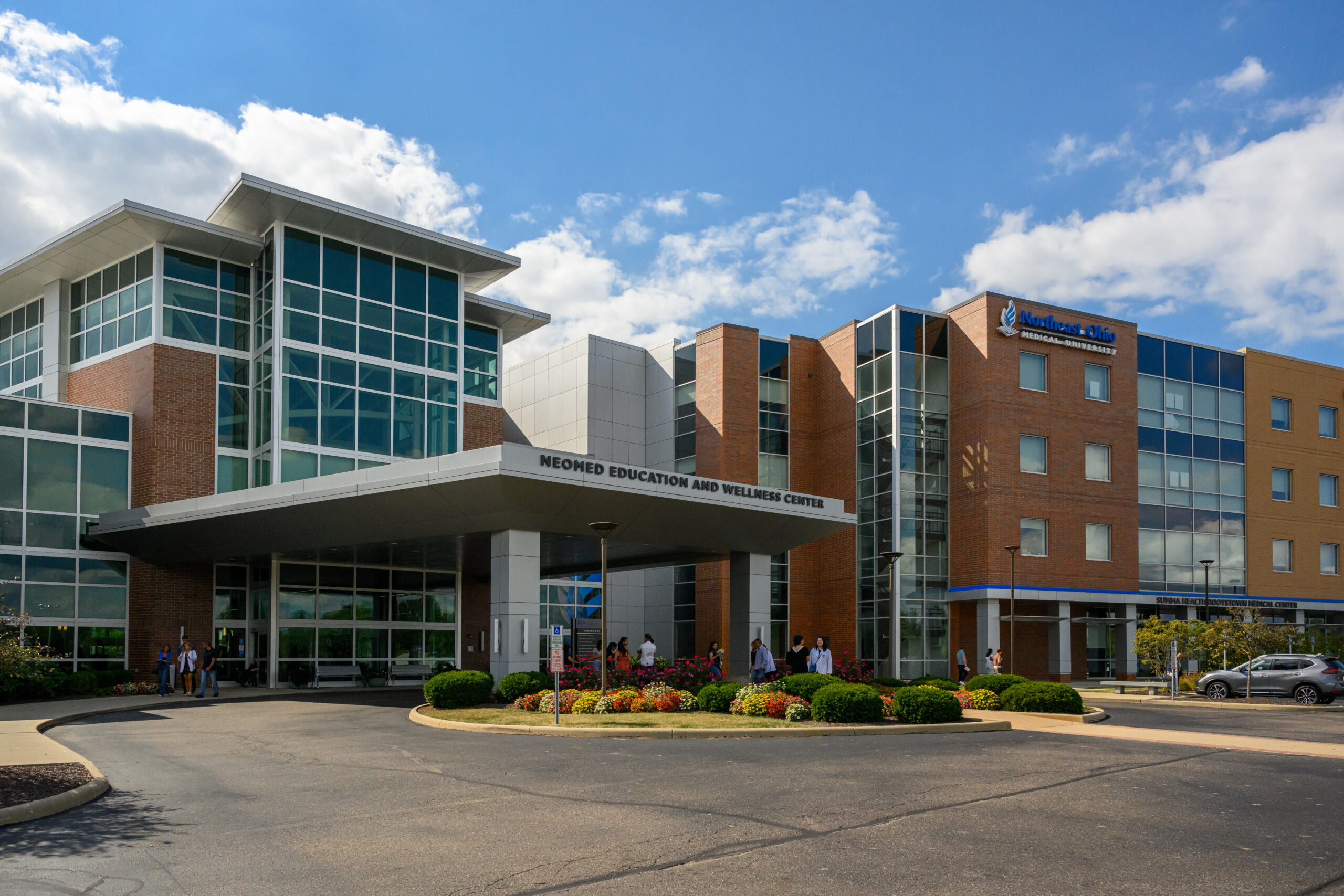
Filling the Gaps
Filling the gaps
NEOMED’s College of Graduate Studies prepares the health care workforce of tomorrow through a range of programs
The Basic and Translational Biomedicine (BTB) program at Northeast Ohio Medical University helps train a new generation of bioinnovators and scientists who are seeking to fill the gaps of the unmet needs for patients.
NEOMED students are putting this into action.
Andrew Muskara and Mustafa Houmsse, graduates of the BTB M.S. program and current first-year medical students, are part of a team that is working to create a life-saving medical device. Their first step, however, was to identify a need.
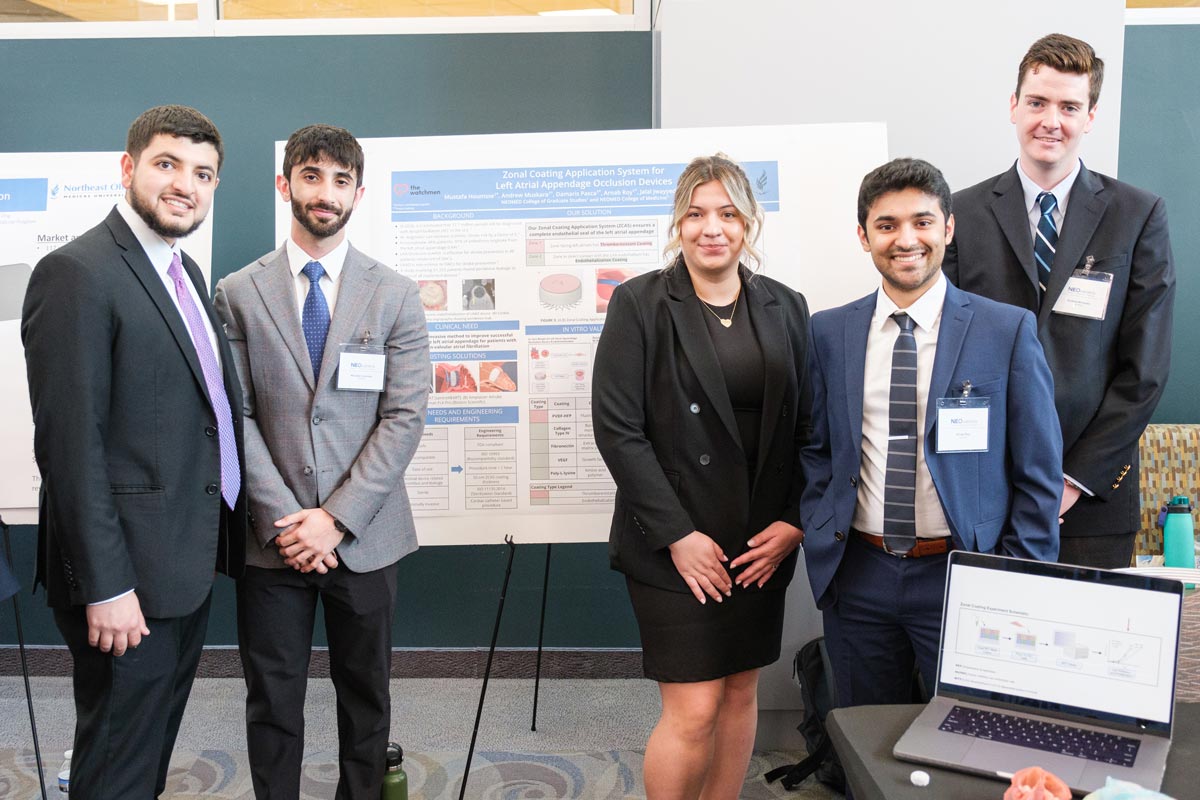
Jalal Jwayyed, second-year medical student, Mustafa Houmsse, first-year medical student, Damaris Pasca, graduate student, Arnab Roy, clinical research coordinator for University Hospitals, and Andrew Muskara, first-year medical student, with the Zonal Coating poster and display at NEOMED’s Bench to Bedside competition.
The team narrowed their focus to the fact that patients with AFib are five times more likely to have a stroke as a result of stagnant blood clotting and exiting the heart. Left atrial appendage occlusion (LAAO) is a promising second-line therapy to minimize stroke risk in AFib patients, especially for those who are unable to tolerate oral anticoagulants or are at an increased risk for bleeding. In this interventional procedure, the left atrial appendage of the heart is physically occluded by an implantable device, preventing thrombus formation and migration from the appendage. However, peri-device leakage and device related thrombus (DRT) are common limitations of LAAO.
To address this issue, the team came up with a novel technique for coating LAAO devices called “Zonal Coating Application System (ZCAS).” ZCAS minimizes peri-device leakage by integrating a two-part thromboresistant and endothelialization-promoting coating onto the device. The end result of the ZCAS is an improved LAAO device that ensures a complete endothelial seal of the left atrial appendage.
Under the guidance of Fayez Safadi, Ph.D., professor of anatomy and neurobiology, the team is working towards getting the device on the market. In Dr. Safadi’s lab, the team developed a novel in-vitro model of LAAO device endothelialization, which they used to validate their ZCAS concept. They presented at the 2024 NEOvations Bench to Bedside Competition, getting feedback from other bioinnovators and investors. The team will be presenting its device at Bench to Bedside as a legacy team in 2025 as they prepare to show the progress they have made in the past year.
Preparing for the Needs of Tomorrow’s Workforce
The health care workforce is in a constant state of evolution. As populations and technology change, future physicians like Muskara will need more than diagnostic skills to thrive.
NEOMED’s College of Graduate Studies is well-prepared to adjust to these shifts. The College continues to grow with programs like BTB that meet the demands of the health care workforce, developing innovative new programs to prepare students for a new world of health care.
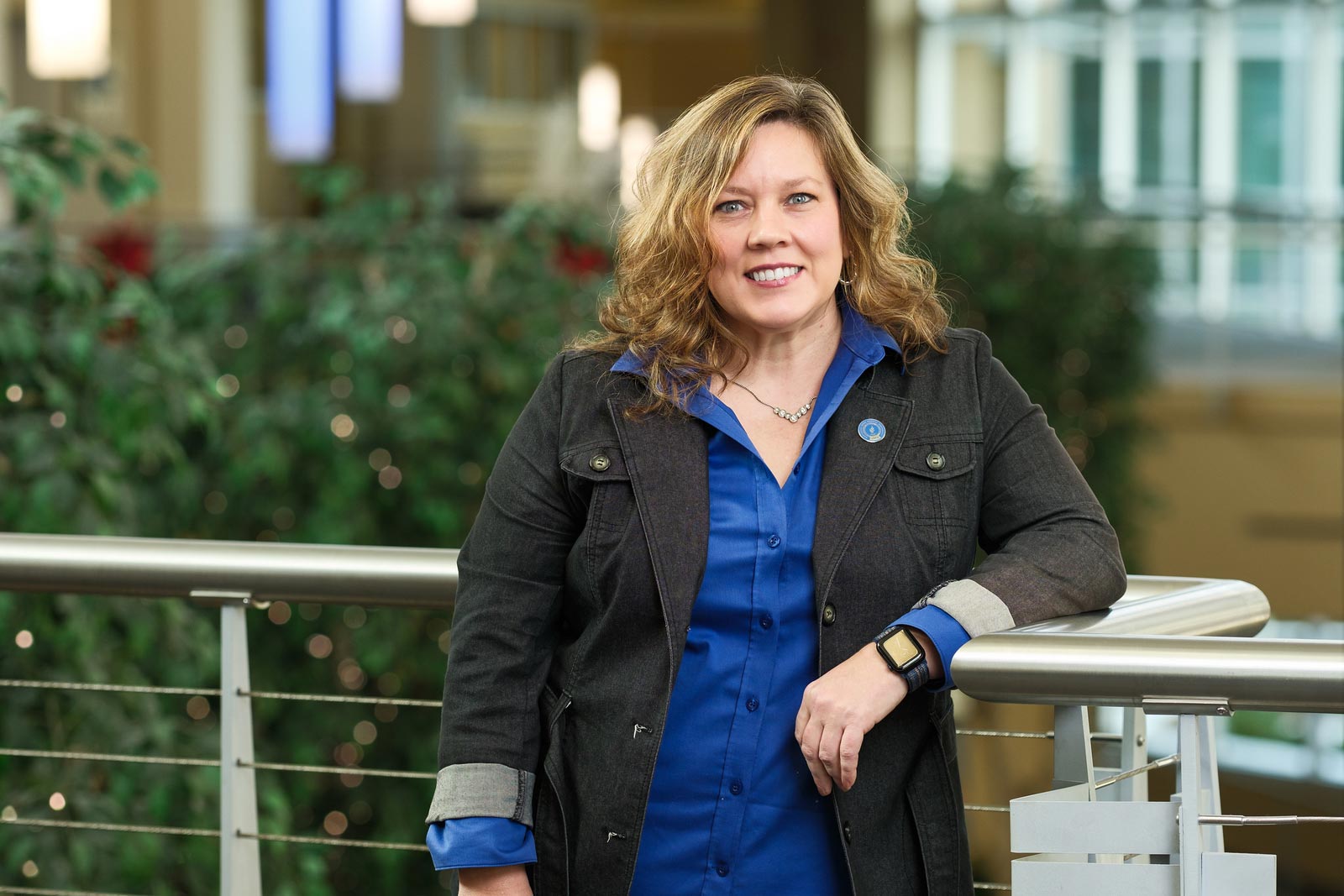
Julie Aultman, Ph.D., dean of the NEOMED College of Graduate Studies
But what about the ethical implications? The Medical Ethics and Humanities program helps learners consider the human element as the health care field dramatically evolves. This portion of the health care team is vital as health care systems navigate what is best for the health of the patient. For instance, the implementation of procedures that allowed people to say goodbye to loved ones through Zoom or using PPV during quarantine.
There is also a demand for greater research compliance to ensure certain ethical demands and other important regulations are being met. This is why a shared course for College of Graduate Studies students, Responsible Conduct of Research, educates students on how every element of the research process should be conducted with integrity. This allows students to serve on agencies such as Internal Review Boards or the Institutional Animal Care and Use Committee, which oversee research involving human and animal subjects, respectively.
“We do a thorough market analysis to determine which professions are growing and what workforce gaps need to be addressed in the near future,” said Julie Aultman, Ph.D., dean of the College of Graduate Studies. “Our primary focus is to provide exceptional education and training, while guiding our students on toward a rewarding career path with an in-demand skillset after they graduate from NEOMED.”
“We do a thorough market analysis to determine which professions are growing and what workforce gaps need to be addressed in the near future.”
— Julie Aultman, Ph.D.,
dean of the College of Graduate Studies
Adding a Crucial Member to the Team
One such career is the certified anesthesiologist assistant.
The College’s Master of Medical Science in Anesthesia (M.M.Sc.A.) program is creating professionals who are ready to immediately enter the workforce as CAAs upon graduation and the passage of a certification exam. The current demand is so strong that many students have job offers within six months of beginning the program, well before graduation.
The two-year program culminates with a several-months rotation at a hospital, which can serve as an orientation process for students before earning their certification.
The M.M.Sc.A. program has been an absolute success in meeting the demands of the health care workforce, as 100% of graduates have had a CAA position lined up prior to graduation.
The demand for CAAs is incredibly high, even though they are only currently licensed to work in 21 U.S. states, as well a Washington, D.C., and Guam. Demand will grow, as more states approve the implementation of CAAs in hospital systems.

Creating a New Profession
Early in 2025, Ohio Gov. Mike DeWine signed legislation creating a new profession to meet the mental health care needs of communities across the state. The Certified Mental Health Assistant (CMHA) graduate degree program, developed by NEOMED, addresses the workforce shortage of mental health professionals. The program will be housed in the College of Graduate Studies.
A CMHA will work exclusively under the supervision of a physician who will make the original diagnosis. The CMHA will carry out the treatment plan as prescribed by the physician.
According to the U.S. Health Resources and Services Administration, Ohio has 138 Mental Health Professional Shortage Areas and 16 Ohio counties are currently listed as Mental Health Professional Shortage Areas.
“This is a historic endeavor that will ultimately save lives,” said NEOMED President John Langell, M.D., Ph.D., M.P.H., M.B.A. “Certified Mental Health Assistants will transform the landscape of mental health treatment by providing greater access to care.”