


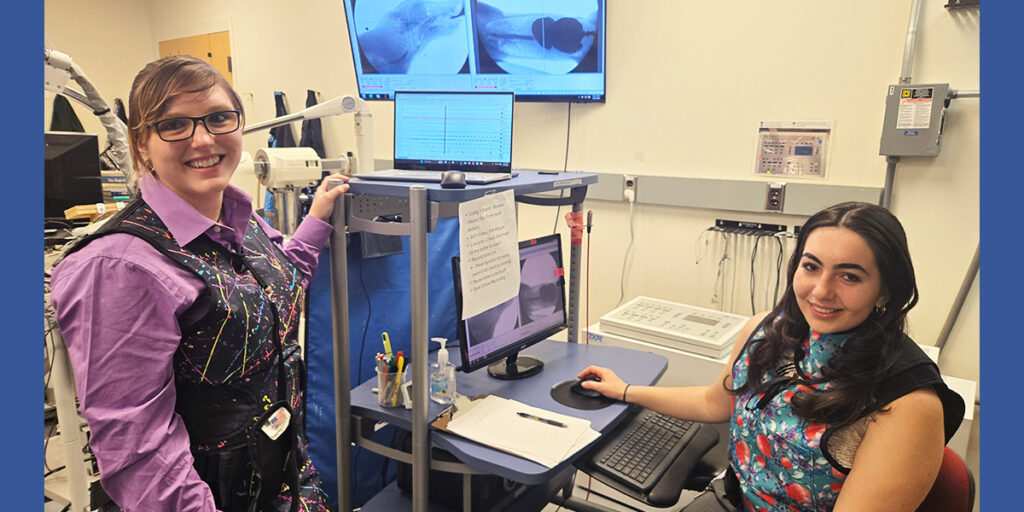
Photo: Research assistant Sarah Sheldon and student Ana Kasumova in the German Lab.
First-year medical student Ana Kasumova was one of more than 200 NEOMED students to present their scholarly work at the 2025 Student Research Symposium. Her presentational, titled “Toward better diagnostics: Integrating aspiration measures in an infant pig model of dysphagia,” earned first place among oral presentations at the event. She shared with The Pulse the inspiration for her work, what she learned and next steps for her research.
What was the inspiration for this project? What led you to the topic?
This project was motivated by the clinical challenges associated with diagnosing and managing dysphagia in preterm infants. Airway protection failure can lead to serious complications, yet current diagnostic tools do not always capture the full complexity of aspiration events. Working in Dr. Rebecca German’s Musculoskeletal Biomechanics Lab, I was drawn to investigating how biomechanical and neural mechanisms interact during swallowing and how these mechanisms fail in vulnerable populations.
Briefly describe the work. What were the key findings you shared?
Our work integrates multiple measures of aspiration within an established infant pig model of dysphagia. By combining videofluoroscopic analysis with physiological and biomechanical metrics, we evaluated how aspiration is identified and characterized across different diagnostic approaches. A key focus was determining whether traditional clinical markers align with underlying biomechanical patterns. We demonstrated that integrating aspiration measures provides a more comprehensive assessment of airway protection and may improve the sensitivity of diagnostic interpretation.
What is the potential impact of the research, especially in terms of human health?
This research has direct translational relevance to human infant health. A more precise understanding of swallowing biomechanics and aspiration mechanisms can inform improved diagnostic criteria and, ultimately, more targeted therapeutic interventions. Enhancing early detection of airway protection failure may reduce the risk of respiratory complications and improve feeding safety in preterm and medically complex infants.
Do you have plans to continue participating in research? What are your career goals?
Yes. I plan to continue participating in research that bridges biomechanics, neuroscience and clinical application. My long-term goal is to pursue a career that integrates rigorous scientific investigation with translational or clinical impact, particularly in areas where mechanistic insight can directly improve patient care.
Anything else you’d like to add?
I am grateful for the mentorship and collaborative environment within the lab, as well as the opportunity to present at the symposium. The experience strengthened my commitment to translational research and scientific communication.