


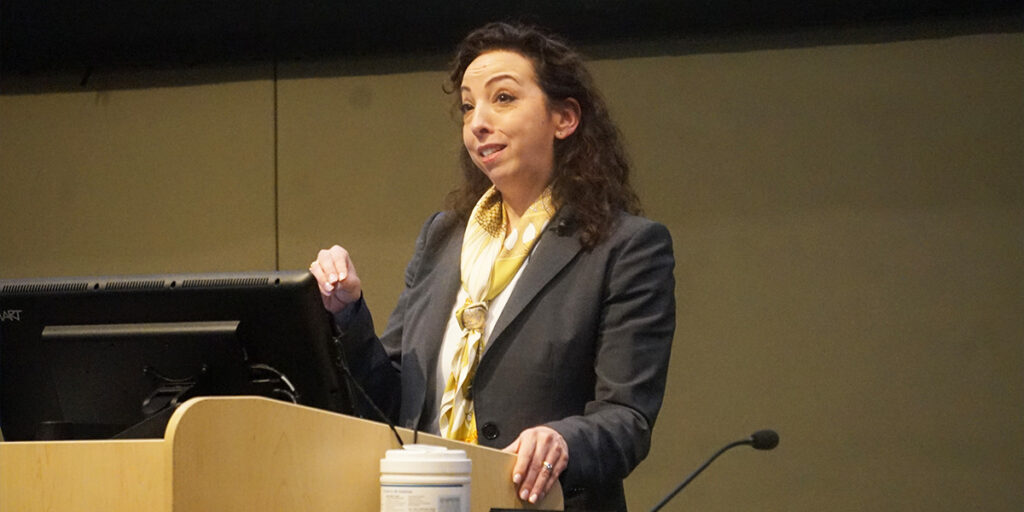
Healthcare–associated infections remain a persistent challenge in clinical settings, but many of the most effective prevention strategies are simple, consistent practices. That was the central message shared by Erica S. Shenoy, M.D., Ph.D., FIDSA, FSHEA, during the Chatrchai Watanakunakorn, M.D., Lectureship in Medicine held March 11.
Speaking to students, faculty and clinicians, Dr. Shenoy, chief of infection control for Mass General Brigham, emphasized that preventing infection in health care environments often comes down to consistent adherence to fundamental practices.

Photo: from left, Ping Zhang, M.D., Ph.D., professor and Watanakunakorn Chair of Integrative Medical Sciences, Marc Basson, M.D., Ph.D., dean of the College of Medicine, Erica S. Shenoy, M.D., Ph.D., chief of infection control, Mass General Brigham, Hans Thewissen, Ph.D., chair and Ingalls-Brown Professor of Biomedical Sciences and Distinguished University Professor, and NEOMED President John T. Langell, M.D. Ph.D., M.P.H., M.B.A.
The Power of Clean Hands
Dr. Shenoy shared a striking statistic: physicians clean their hands only about 40% of the times they should. Yet hand hygiene remains one of the most effective ways to prevent infection.
“Clean hands save lives,” she emphasized.
According to Dr. Shenoy, about 80% of infections are spread by hands, and contact transmission accounts for 40–60% of healthcare–associated infections. These numbers underscore why proper hand hygiene remains a cornerstone of infection prevention. She also reminded the audience that gloves are not a substitute for hand hygiene and encouraged clinicians to serve as role models for colleagues and trainees.
The Hidden Risks in the Care Environment
Beyond hands, Dr. Shenoy highlighted environmental risks that can contribute to infection spread. Often-overlooked sources are sinks and drains within healthcare settings.
“Sinks and drains can serve as reservoirs for pathogens,” she explained, noting the importance of thoughtful placement of supplies and proper maintenance of these areas.
Practicing sink hygiene, such as keeping medical supplies at least three feet away from sinks and avoiding contamination of surrounding surfaces, can help reduce these risks.
Dr. Shenoy also emphasized the importance of engineering controls and respecting the environment of care, the physical environment in which healthcare is delivered. Maintaining a clean, sanitary clinical space is a shared responsibility that directly impacts patient safety.
A Call to Lead by Example
Throughout the lecture, Dr. Shenoy encouraged physicians and trainees to take an active role in infection prevention by modeling best practices and speaking up about potential risks.
“Be a role model,” she said. “Tell people about the risk.”
Her key takeaways were clear and actionable:
- Clean hands save lives.
- Sinks and drains can pose infection risks.
- Respect the environment of care.
By reinforcing these essential practices, clinicians can help create safer environments for both patients and health care professionals.