


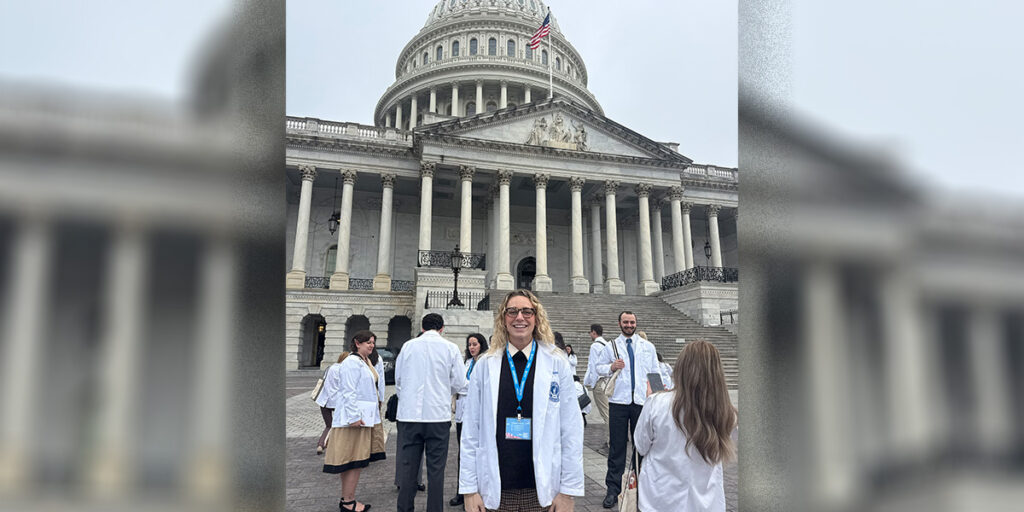
The AMA Medical Student Advocacy Conference (MAC) is the American Medical Association’s largest advocacy event and conference for medical students. It provides students with advocacy training, access to legislators, opportunities to network with peers and a platform for students to advocate for changes in public health policy. Second-year medical student Molly Oertel attended this year’s conference, and shared the following reflection on the experience:
I chose to attend the conference, not only because it was close to home on spring break, but because it was centered around learning how to advocate for legislation that I believe in to government leaders. Growing up in Maryland (neighboring D.C.), and attending a college located on the D.C. metro line, I have always been interested in politics because it has always surrounded me. Additionally, from a young age I know I have always wanted to run for my local county council or participate in local or state government in some way. So, when I saw the opportunity for medical students to meet with legislators and bring talking points that are of importance to not only medical students, but to the patients we will eventually treat, I immediately signed up.
I was really happy with how this conference turned out and what I learned. On the first day, we had sessions that talked about three different policy points that we wanted to bring up to our legislators, including increasing NIH funding, the REDI act and increasing transparency in pharmacy benefit managers (PBMs). The REDI act is a piece of bipartisan legislation that is gaining support; the legislation states that medical residents will not gain interest on their loans during their years of residency when they are receiving minimal income compared to the amount of hours they work. We also learned more about the current affairs of today’s government, including a talk from the Senate Majority Whip, John Barrasso, who is a physician himself.
The next day was what really made the conference special. We had meetings on “the hill” all day with legislators or their staffers from both political parties. I signed up to be with the Ohio group, since I am now a resident of the state and my vote holds a little more weight here. It was such a neat experience to be in the senate and house buildings, actually talking to the leaders that can make a difference in legislation that affects my patients and me. No matter what political party the legislator was from, their staffers were receptive to what we were saying and wrote down our points. The best part, to me, was talking to a staffer of Representative Emilia Sykes of Ohio’s 13th district (mainly encompassing Akron, Canton, parts of Portage County, Kent and Streetsboro). Although Congresswoman Sykes couldn’t attend, as she was home in Akron, we spent a long time discussing not only our lobbying points, but the large role that Summa Health system plays in Summit County.
I would highly recommend this conference to anyone thinking about going! It is a great way to learn not only about healthcare policy and its advocacy, but also the innerworkings of our country’s congress. Although this lobbying was on a large platform, it also teaches me how to be an advocate in a local community too. Even the staff from Congresswoman Sykes office told me to keep bringing these points to city council leaders, since, oftentimes, change starts small in your local community. Also, I really enjoyed connecting with other medical students in Ohio (many of whom knew a lot of my classmates), and students from all over the country.