


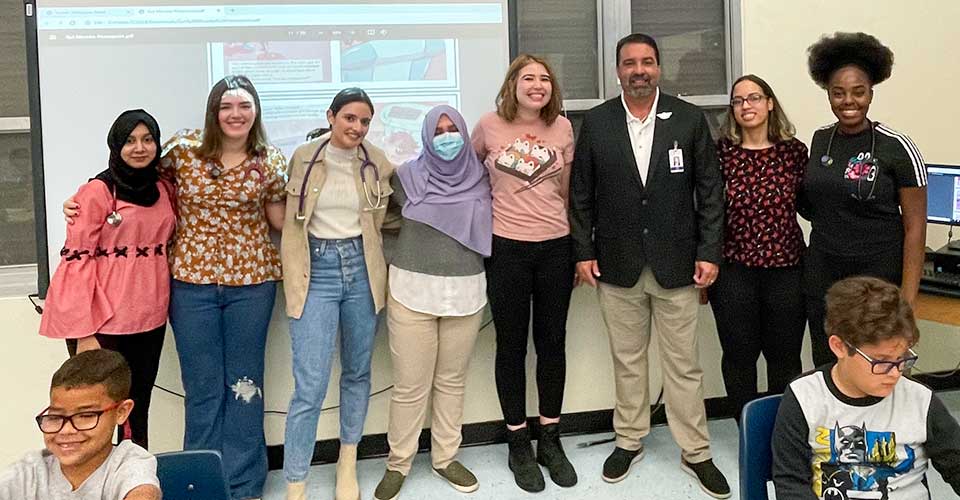
 Before coming to NEOMED as a student in the College of Medicine, Lauren Falcon, right, taught environmental topics to 10th and 12th grade students as a high school teacher in Miami, Florida.
 “I have always had a passion for promoting the importance of education and uplifting minority students through knowledge,” Falcon, a first-year medicine student in the Social Justice Pathway, said.
Falcon returned to Florida in December 2022 to share a STEM educational program she developed – titled Whiz Kids – to teach first and fifth grade students at Bent Tree Elementary School about gut microbiome and pumping hearts. She was joined by Leslie Gonzalez, M1, and Sofia Mesa, M2, who learned of Falcon’s plans for the program during a meeting of the Latino Medical Student Association.
A love for teaching and medicine
“Whiz Kids was an event I pulled together this past winter break to combine my love for teaching and medicine. I had so much fun searching for educational materials, putting together lesson plans, and presenting in front of a class. It felt just like old times!” Falcon said.
In the Whiz Kids program, the elementary school students listened to a fun story, learned about medical equipment and had the opportunity to perform experiments to apply what they learned during the day.
“I genuinely feel that these kids now have a better understanding of the importance of eating healthy and playing outside. It makes me happy thinking about the possibility of having influenced a future physician in the making,” Falcon said.
Gonzalez shared, “Once I heard about Whiz Kids, I thought it would be a good opportunity to teach the next generation about human physiology. A lot of students, especially younger students, don’t do well with integrating lessons taught in class with their own lives and with the world around them, and I felt like this opportunity would be able to facilitate that integration.”
The impact of the program may reach well beyond what any individual student learned.
Healthier lifestyle
“Most of the elementary students we taught that day were Hispanic like myself and a good portion were even considered English Language Learning (ELL) students,” Falcon noted. “In a way, sharing what we know made a healthier lifestyle that much more accessible and addresses the lack of education, which can serve as a social determinant of health. Moreover, our small act ensured the elementary school would meet their STEM requirement that is needed for funding the following year. This allocation of money for STEM means the world to these teachers, being that it allows them to step outside the box and embrace innovation.”
Mesa added, “The kids had a great time learning about the heart and gut microbiome. A lot of them said they wanted to pursue medicine and I loved hearing this from young Hispanic children.”
The young students weren’t the only ones to gain something from the program. “Through this experience, I became more comfortable working with kids and I got to practice teaching, which I had not really done previously,” Gonzalez noted. “I thought the experience was fun, and I’m glad Lauren invited me to do this.”
Falcon is planning to coordinate another Whiz Kids program during the next winter break.