
NEOMED COLLEGE OF MEDICINE
Biomedical Sciences
Educating future healthcare professionals while advancing scientific discovery

Jessica M. Ferrell, Ph.D.
Assistant Professor, Department of Biomedical Sciences
jfrancl@neomed.edu
Ferrell Lab
Overview
Our lab studies bile acid physiology and signaling within the context of metabolic liver disease, which is growing in prevalence in the United States and globally. Bile acids are physiological detergents that help digest fat in food, and they also regulate glucose and cholesterol homeostasis in the liver, brain, and other tissues by binding to bile acid receptors. The liver and brain interact to ensure we adapt appropriately to changes in nutrient status and time of day as well as to pathological stimuli. Chronic pathological insults (in the form of high fat diets, alcohol, high blood sugar or high cholesterol, circadian disruption, or genetic factors) all contribute to the progression of liver disease that can result in liver cancer or liver failure. Our goals are to study:
- how metabolic liver disease disrupts critical bile acid metabolism, and
- how bile acid signaling can be exploited as a therapeutic target for liver disease.
Current work
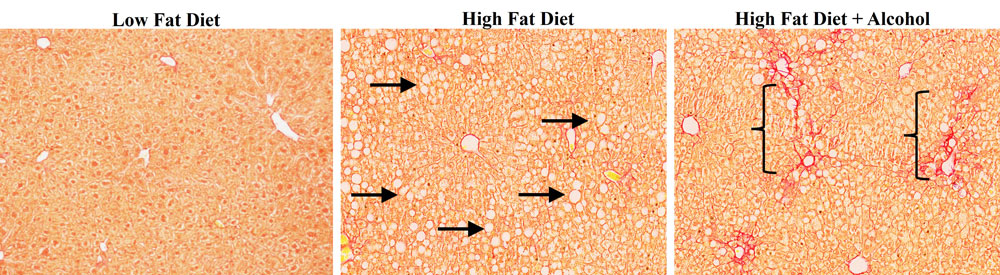
Steatosis-to-steatohepatitis transition
It’s estimated that about 25% of the global population are living with steatosis (fat deposition in the liver), which often occurs along with obesity and/or Type 2 diabetes. Steatosis, while relatively benign and reversible, can progress to steatohepatitis (fatty liver + inflammation), or fibrosis & cirrhosis (scarring) if left untreated. We are investigating the progression of liver disease due to high fat diets and alcohol. While high fat diet alone can cause fat to accumulate in the liver (steatosis), high fat diet that is chronically consumed with alcohol can lead to liver fibrosis and inflammation. We are identifying the genes and proteins that trigger disease progression, with the hope of identifying new treatment targets and preventing the transition to serious liver injury.
Interactions of metabolic & neurodegenerative disease
Bile acids are studied for their therapeutic value, and they have more recently been recognized as neuroprotective agents. However, how bile acids exert their effects in the brain is unknown, as is whether those effects are a result of direct activation of bile acid receptors or indirect modulation of other metabolic pathways. We are currently studying bile acid signaling in the brain and investigating the downstream effects, from molecular pathways to overt behavior, to identify new drug targets for neuroinflammation and neurodegeneration.
Funding/support
Our research has been funded by the NIH (NIDDK, NIAAA) and University Hospitals-NEOMED Faculty Scholar Funds.
Select publications
Olotu T, JM Ferrell. Lactobacillus sp. for the attenuation of steatosis and MASLD in mice. Microorganisms. 2024. 12: 2488. PMID: 39770690.
Ferdous S-E, Ferrell JM. Pathophysiological relationship between Type 2 diabetes and metabolic dysfunction-associated steatotic liver disease and their novel therapeutic approaches. Int. J. Molec. Sci. 2024. 25: 8731. PMID: 39201418.
Ferrell JM, Dilts M, Pokhrel S, Stahl S, Boehme S, Wang X, Chiang JYL. Fibroblast growth factor 19 alters bile acids to induce dysbiosis in female mice with alcohol-induced liver disease. Cell. Molec. Gastroenterol. Hepatol. 2024. 18: 71-87. PMID: 38417701 .
Pokhrel S, Dilts M, Stahl Z, Boehme S, Frame G, Chiang JYL, Ferrell JM. Tgr5-/- mice are protected from ethanol-induced metabolic alterations via enhanced leptin and Fgf21 signaling. Hepatol. Commun. 2023. 7: e0138. PMID: 37185802.
Ferrell JM, Dilts M, Stahl Z, Boehme S, Pokhrel S, Wang X, Chiang JYL. Altered serotonin metabolism in Tgr5-/- mice protects against diet-induced hepatic fibrosis. Liver Res. 2022. 6: 214-226. PMID: 39957909.
Ferrell JM and Chiang JYL. Bile acid receptors and signaling crosstalk in the liver, gut and brain. Liver Res. 2021. 5: 105-118. PMID: 39957847 .
Select collaborators
College of Medicine: Priya Raman, Jianguo Wu
College of Pharmacy: Sheila Fleming, Christine Dengler-Crish, Matthew Smith, Xinwen Wang, Takhar Kasumov
Open positions
See open positions in this lab on the NEOMED careers site.
Lab members
Shifat-E Ferdous, M.S.
Kent State University, BMS Ph.D. Candidate
Titilayo Olotu, M.S.
Kent State University ,BMS Ph.D. Candidate
Contact
Deborah Heeter
Email | 330.325.6636
Department Chair
J.G.M. ‘Hans’ Thewissen, Ph.D.
Phone: 330.325.6295
Email: thewisse@neomed.edu
Department of Biomedical Sciences
Department of Biomedical Sciences home
College of Medicine home page