


The Greatest Sort of Public Service (Summer 2024)
The greatest sort of public service
Remembering Robert Liebelt, M.D.
Just one month following our interview, Dr. Liebelt died quietly while in hospice on Dec. 16, 2023. He was 96. Ignite is honored to share his final interview as a tribute to his service as a physician, educator and mentor.
When he returned from the Navy to his hometown of Chicago, Robert Liebelt decided he wanted to get a job working on the city’s bridges. The idea of building something appealed to him.

A turret gunner during World War II, Liebelt was good with his hands, and bridge work — with its engineering science, construction and public good — seemed naturally a good fit. But it wasn’t meant to be.
“I was very proud that I served in the Navy,” Liebelt shared. “And when I got home, I didn’t know what I was going to do. It was my mother who suggested that I consider a career in medicine.”
No matter how much wisdom or experience one acquires. No matter how many kids, grandkids, great-grandkids one may have of their own. No matter how many decades one spends on this earth — Bob was in his 10th — one still remembers what Mom said.
Mother knows best
 Heeding his mother’s advice, Liebelt went on to earn several degrees — B.S., M.S. and Ph.D. — on his path to medicine. He obtained his M.D. degree at Baylor University College of Medicine in 1958. Dr. Liebelt remained at Baylor, serving as faculty before being recruited as chair of anatomy by Stanley Olson, M.D., the college’s dean who had helped develop Baylor’s College of Medicine.
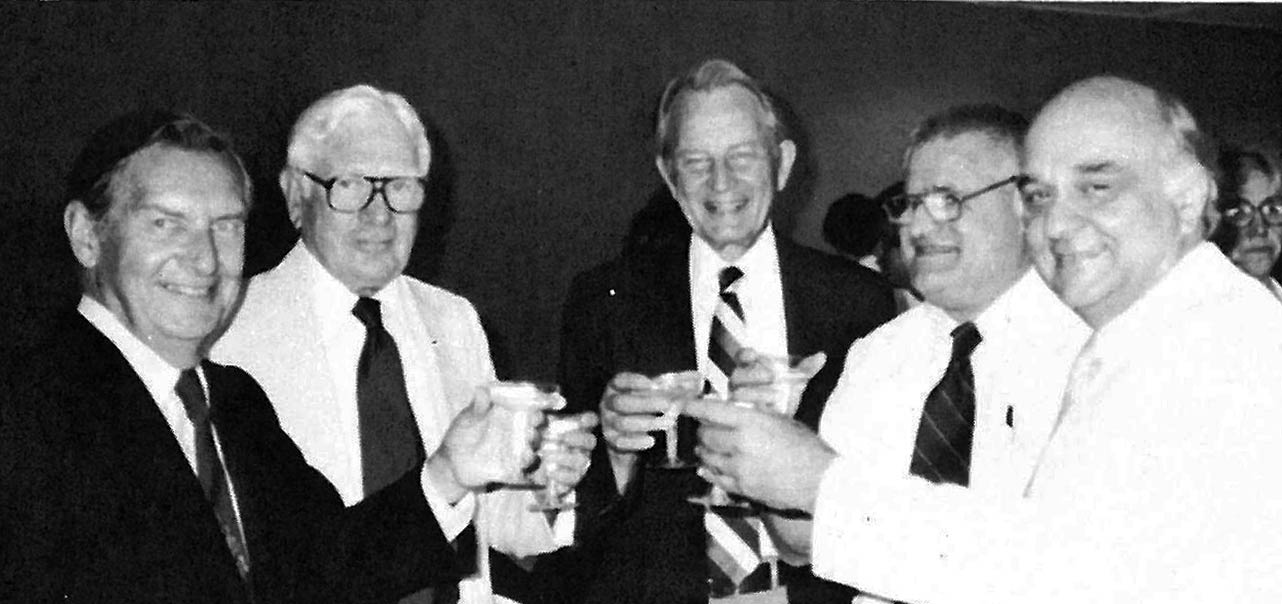
The two became friends and while both would eventually move on to other universities, some 20 years after first meeting, they would work together again. Dr. Liebelt had been serving as the provost at the Medical College of Georgia at Augusta when he received an invitation to help build upon a field of dreams located in Rootstown, Ohio.
An architect needs a great builder. And for that, Stanley Olson recommended Dr. Liebelt.
But an architect needs a great builder. And for that, he recommended Dr. Liebelt.
The construction manager
In January 1974, Dr. Liebelt received a call from his old friend Dr. Olson.
“He called me when I was at Georgia and asked if I would come up here and start the medical school with him. And I said, okay. So, I moved from Georgia to Ohio,” said Dr. Liebelt.
He was initially asked to serve as consultant to the consortium’s three universities on their life sciences curriculum. The new college had just been established Nov. 23, 1973. The location of the school had not been decided. There were no buildings. No dean. So, Dr. Liebelt’s invitation to consult included a consideration for the fledgling college’s inaugural dean position.Dr. Liebelt added, “(it was) an open field. Nothing else existed.”
With an aggressive architectural and construction plan now in play, Dr. Olson and others had laid a foundation for Dr. Liebelt to design a program for the new College of Medicine to begin offering basic medical sciences to students in September 1977. Pathways with consortium colleges were developed to prepare minority and rural high school students interested in the sciences. Dr. Liebelt led the unenviable task of convincing students, parents and others that despite having no facilities, this future medical school was the place for them to earn their medical education.
A class of their own
As if accelerating hiring and curriculum development weren’t enough, Dr. Liebelt also had to expedite the preparation and training of pathway students from The University of Akron, Kent State University and Youngstown State University. Drawing from his experience as admissions committee chair at Baylor, Dr. Liebelt formed a joint promotion review committee. Students who successfully completed two years of undergraduate study at the pathways schools would not have to compete with direct applicants to the new medical school. According to Silver Reflections: A History of the Northeastern Ohio Universities College of Medicine 1973-1998 by Margaret J. Neuman Dietz, students who were members of that charter class remember that feature as the most enticing part of the program — acceptance into medical school was particularly competitive.
The Bachelor of Science/Doctor of Medicine program (B.S./M.D. program) was born.
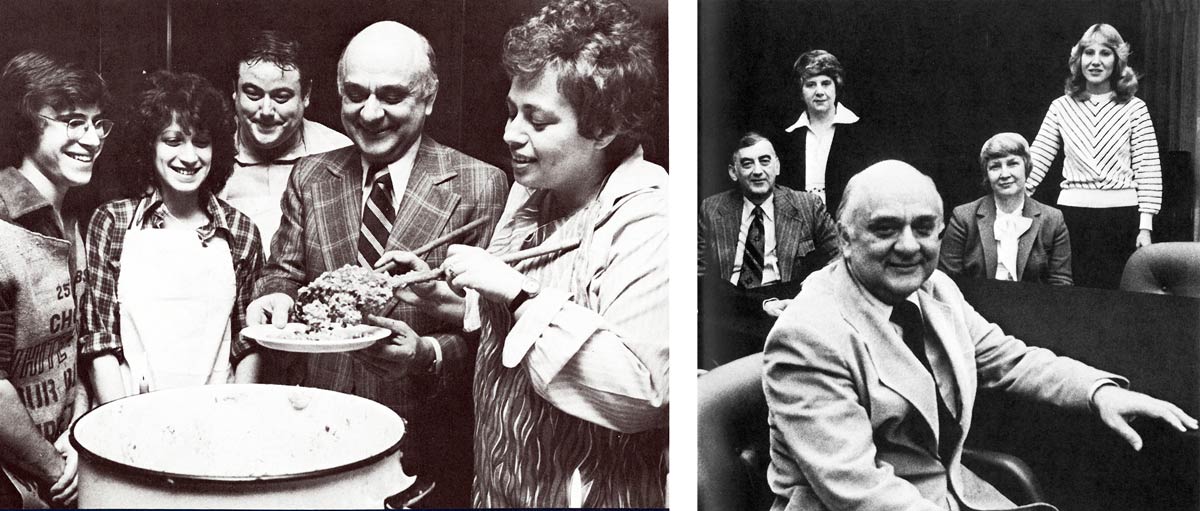
Six months later, on the recommendation of Dr. Olson, Dr. Liebelt was appointed as the first dean of NEOUCOM on July 8, 1974. He’d be responsible for recruiting and hiring faculty, and administering the development of curriculum, student admissions and consortium associations. Around that same time, a 54-acre farm near the intersection of Interstate 76 and State Route 44 was purchased to build the campus facilities.
The new college had just been established Nov. 23, 1973. The location of the school had not been decided. There were no buildings. No dean.
He said, “Why do we do global health? We know the world is more connected now than ever before. We live in a global economy. And we can be anywhere in the world today well within the incubation period of a lethal, infectious disease. We are closer together. We are more connected interdependently and globally than we have ever been. And yet, when you look at the world today, we are much more challenged than perhaps any time in the past.”
To illustrate, Dr. Faison noted that most of the goods that come to the U.S. are from Asia, where 70% of the world’s national disasters also occur. The severity of those disasters is getting worse because of climate change.
“Because of climate change, resultant crop failures and water shortages, we are seeing mass migrations of people to the coast,” noted Dr. Faison. “What you’re seeing is the rise of coastal mega cities, cities that were never intended to be called upon to manage the size of the populations that they’re now managing.”
The American way of life and access to goods and services depend heavily on global stability and global peace. Natural disasters or displaced populations can be just as disruptive as global conflict and such cities have become breeding grounds for infectious diseases, which can spread very quickly. There’s also concern over clean, fresh water. Availability of fresh water may be our next global crisis and cause of conflict.
Drs. Liebelt, Olson and many others had made a field of dreams come true for many.
On Sept. 12, 1977, NEOUCOM welcomed its first class of 48 students (six with traditional bachelor’s degrees had also been accepted from other Ohio schools).
Drs. Liebelt, Olson and many others had made a field of dreams come true for many. While all buildings and offices weren’t quite ready to be occupied, the class that began in the auditorium that day joined Drs. Liebelt and Olson as part of history.
Charter members
With a little assistance, Dr. Liebelt began reeling off faculty names. “So, Ted Voneida [neurobiology], he was down from Cleveland at Case Western. And Saltzman, yeah, I remember Glenn [behavioral sciences] … and Norman Taslitz [anatomy]. Well, I have been thinking about these for quite a few number of years,” he said.

Upon overseeing the University’s first commencement and conferring degrees to the charter class of 1981, Dr. Liebelt officiated over the presentation of 42 Doctor of Medicine degrees at E.J. Thomas Hall in Akron.
Dr. Liebelt became provost and dean in February 1979.
Upon overseeing the University’s first commencement and conferring degrees to the charter class of 1981, Dr. Liebelt officiated over the presentation of 42 Doctor of Medicine degrees at E.J. Thomas Hall in Akron.
A few months later in November of 1981, Dr. Liebelt announced his resignation after accepting a position at St. Thomas Hospital Medical Center (Summa Health). His official last day was in September 1982 as he remained to ensure the College of Medicine that he helped build would be a sustainable model for decades to come.
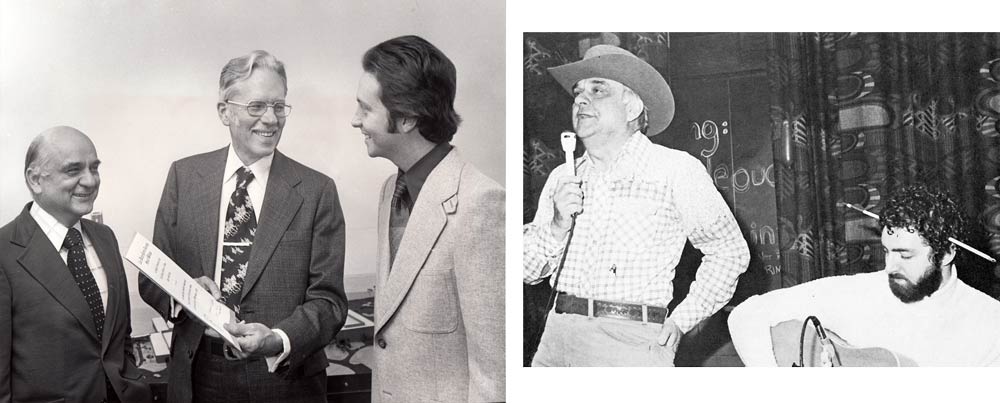
Another half-century of creating transformational leaders with Dr. Liebelt’s founding legacy of anatomy and neurobiology, communication and empathy would be just fine.
Photos from NEOMED archives
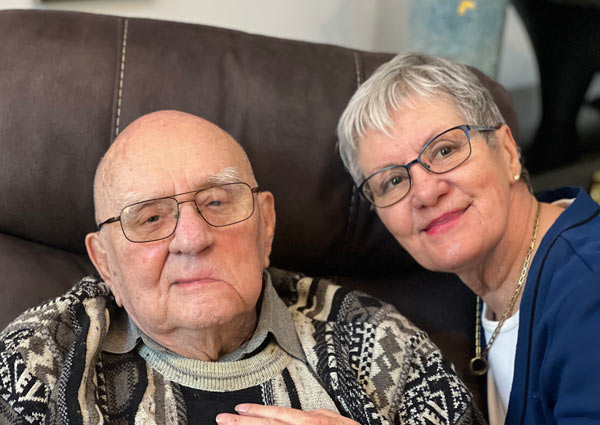
Dr. Liebelt with his wife, Milotka, in 2023.
Golden Reflections podcast
Embark on an auditory adventure through the history of NEOMED on the Golden Reflections podcast series, available on Spotify.
With each episode, listeners are invited to travel through time, from NEOMED’s humble beginnings to current strategic partnerships, uncovering the triumphs, challenges and pivotal moments that have etched our legacy. Led by the Office of Alumni Relations, the podcast delves into the 50 years that have shaped NEOMED into the health sciences university it is today.