


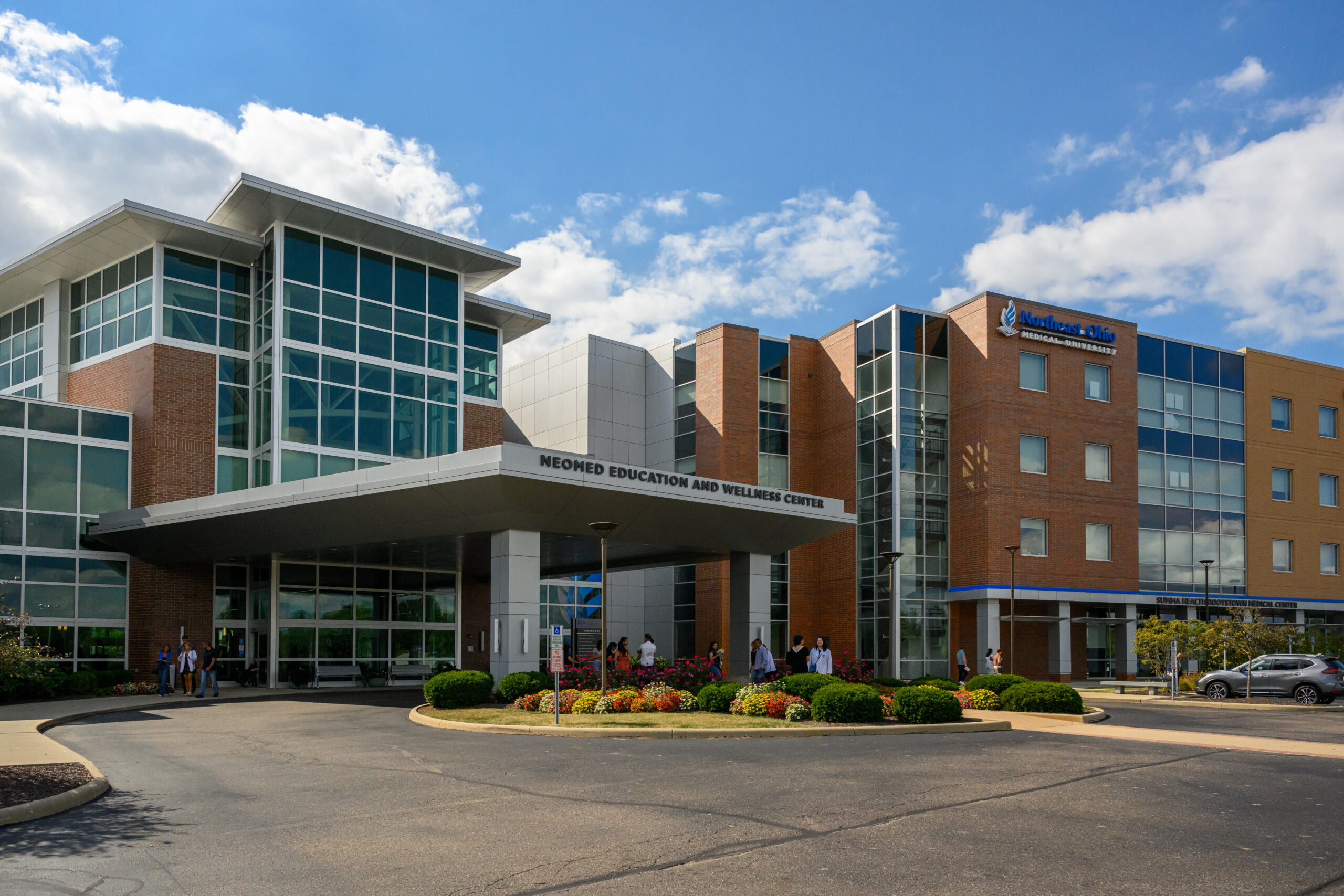
Physician Entrepreneur
Alumnus Amol Soin, M.D., parlayed curiosity into success
When Amol Soin, M.D., began the six-year B.S./M.D. program at Northeast Ohio Medical University, he expected to have a successful, but traditional, career in medicine.
By the time he completed his residency at Rush University and a fellowship at Cleveland Clinic, the 2002 NEOMED alumnus realized clinical training was just the beginning. “I’m a naturally curious person,” he said.
“In addition to my residency and fellowship, I got two master’s degrees in science from Dartmouth [College] and Brown [University], and then an M.B.A. from the University of Tennessee, which helped me a ton because it was a physician-based M.B.A.”
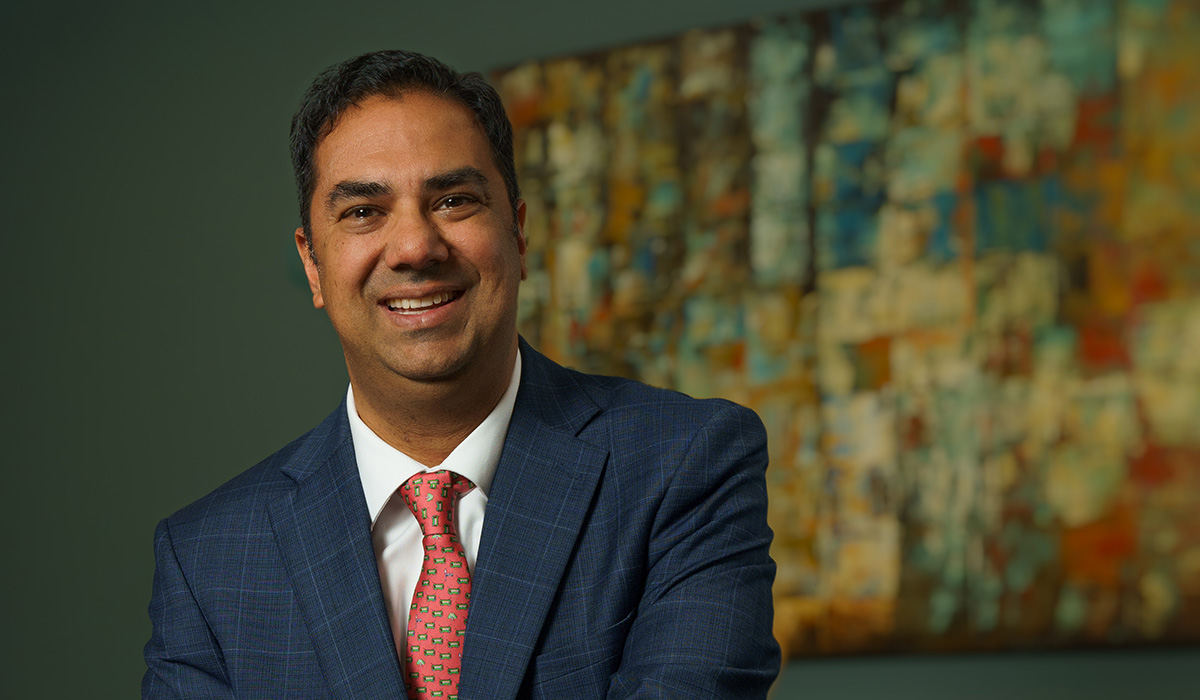
Caption: Amol Soin, M.D. is clinical assistant professor of surgery at Wright State University Boonshoft School of Medicine in Dayton, Ohio. Photo courtesy of Amol Soin, M.D.
His M.B.A. cohort included both experienced physicians and new medical school graduates who challenged his thinking and helped him refine his business model. “It felt like I not only got a degree, but free consulting out of it,” he joked. “By the time I was done, I opened a practice and went for it.”
“It” is Ohio Pain Clinic, a freestanding, multidisciplinary pain management center, which Dr. Soin opened in 2007 in his hometown of Dayton.
From the start, Dr. Soin was committed to an integrated approach to pain management. “You have to address the social and emotional aspects of pain in addition to the physical,” he said. “Sometimes there’s no surgery, no pill that’s going to fix things. People still need help. Psychological therapy, coping mechanisms—all those are integral.”
WATCH: Dr. Soin shared his insights on “Physician research: How to go from concept to prototype to building a company” on VITALS | Visionary Health Leadership in Action. VITALS is NEOMED’s health leadership speaker series presented with University Hospitals.
Roots of Entrepreneurship
Dr. Soin traces his entrepreneurial spark back to the 1990s, when he attended a wedding during the height of the dot-com boom. Surrounded by young founders building companies and raising capital, he wondered how that same energy might apply to healthcare. “Nearly 20% of the U.S. GDP is healthcare,” he said. “It’s one of the largest industries out there, so there have to be innovative opportunities to deliver care cheaper, more efficiently, better.”
As he explored medical specialties from cardiology to orthopaedics to nephrology, pain management stood out. “I realized that in pain, we’d been doing the same thing for four or five decades: derivatives of aspirin or morphine,” he noted. “They don’t work all that great, and they all have baggage. Meanwhile, people are still in pain. I thought, this is a cool opportunity.”
“I wanted to create something nobody had done before.”
— Amol Soin, M.D.
That mindset eventually led him beyond clinical practice and into the world of patents, devices and biotechnology. He also spent a year as president of the American Society of Pain Physicians; in that one year he published more than 20 journal articles. But that work didn’t energize him. “I realized that getting a patent—that’s exciting,” he said.“To prove you’re the first person ever to think of something in the history of recorded time; that’s a high bar. I wanted to create something nobody had done before.”
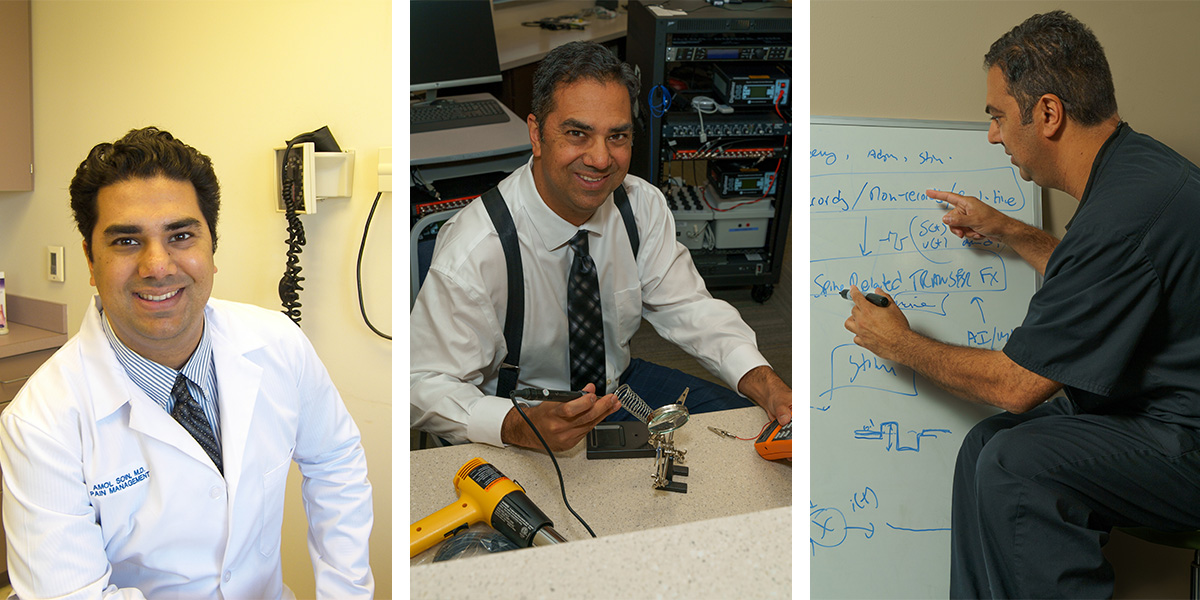
Caption: Left to right: Amol Soin, M.D., in the clinic, in his lab and in the classroom. Photos courtesy of Amol Soin, M.D.
Breakthrough Ideas
His first patent was a pharmaceutical pill for diabetic neuropathy using sodium nitrate, a compound more commonly associated with preservatives in bacon and bologna than with biomedical innovation. But sodium nitrate has properties that promote blood vessel and tissue regrowth, including nerve repair.
Dr. Soin ran clinical trials and ultimately licensed the drug to Cleveland Diabetes Care in a $225-million arrangement that included royalties and milestone payments.
As his success grew, so did his credibility with potential partners and investors. “After something like that happens, funding becomes a lot easier,” Dr. Soin noted. “People think lightning might strike twice.”
His second major venture emerged during his fellowship year: a nerve stimulator to treat amputation stump pain, developed in part through the BioEnterprise business incubator in Cleveland. Dr. Soin played a role in helping to build a company, called Neuros Medical, around the device. The path to approval from the Food and Drug Administration took far longer than expected. “We started in 2008 and thought we’d be approved by 2012 or 2013,” he said. “We got approved in 2024. Sixteen years!”
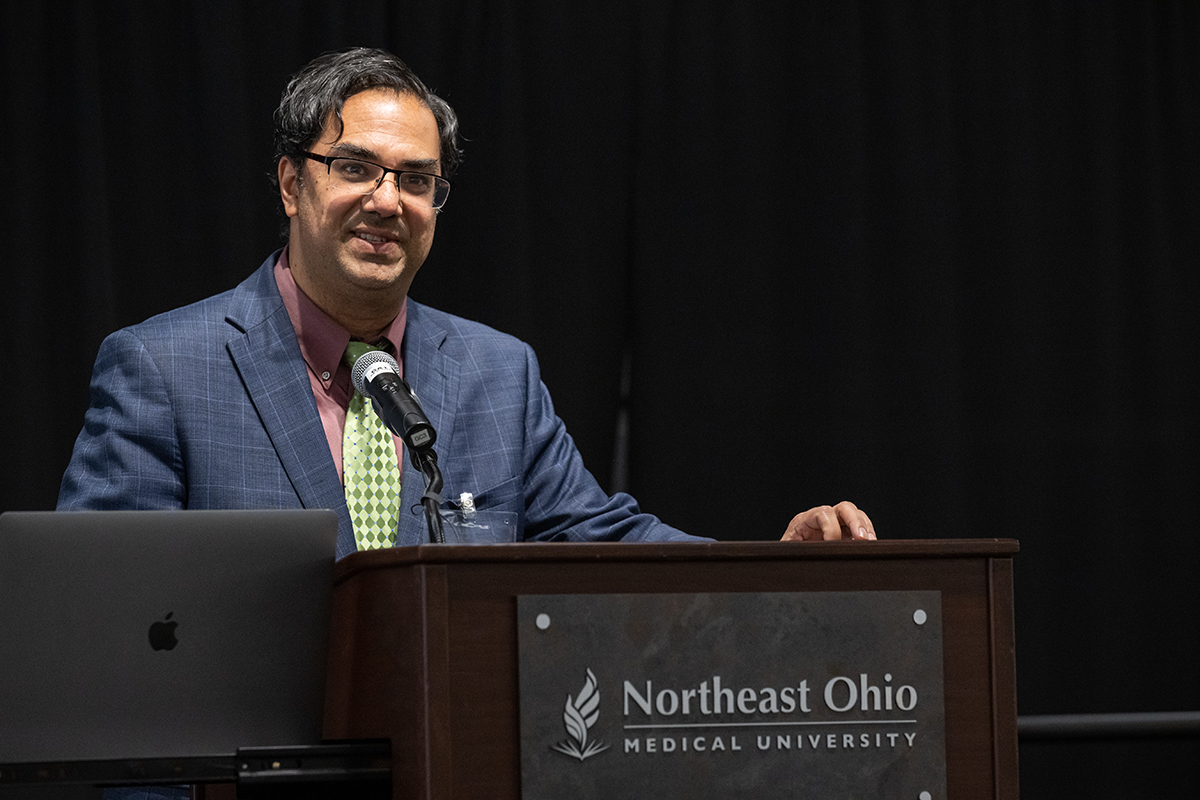
Caption: Amol Soin, M.D., was keynote speaker for the 2025 NEOvations Bench to Bedside competition showcase at NEOMED. Photo: Chris Smanto.
Staying Energized
For all of his innovations, Dr. Soin acknowledges that clinical practice can become routine. “It’s fun for about 10 years, and then your second 10 years, it just becomes like a job,” he said. To keep himself energized, he structures his days into “pods,” that is, distinct four-hour blocks dedicated to different types of work.
“One pod might be seeing patients in clinic; another might be doing procedures. Another is political work. I’m on the State Medical Board of Ohio. Another pod is innovation: companies, patents, lab work,” he explained. “When you start a new block, it feels new. You bring a different energy.”
He traces this approach back to lessons learned while preparing for Step One exams at NEOMED, where he and his roommates lived in what he called a “pressure cooker of studying.”
His solution: a mandatory 30-minute break every evening to “do something totally awesome.” The ritual, he said, gave him and his friends something to look forward to and kept them sane.
Many of those roommates remain close friends, including members of a long-running “fancy football” league (a name born from a father’s misheard comment mistaking fantasy football for fancy football) for the last 26 years.
WATCH: Amol Soin, M.D., shared his journey as a physician entrepreneur with medical students at the NEOvations Bench to Bedside program.
Lasting Impact
Reflecting on the arc of his life and career, Dr. Soin notes that things could have turned out very differently if he had not attended NEOMED. “You don’t understand the impact of your decisions when you’re 18,” he said. “I wouldn’t have met my wife. I wouldn’t have the family I have now. I wouldn’t have had the same hunger or friend group. All those were ingredients that became the recipe of my life as it exists today. And for that, I’m grateful.”