
Graduate Certificate in Global Health and Innovation
For independent, critical thinkers who want to strengthen health systems — locally or internationally
Curriculum
Course requirements for the Certificate in Global Health and Innovation.
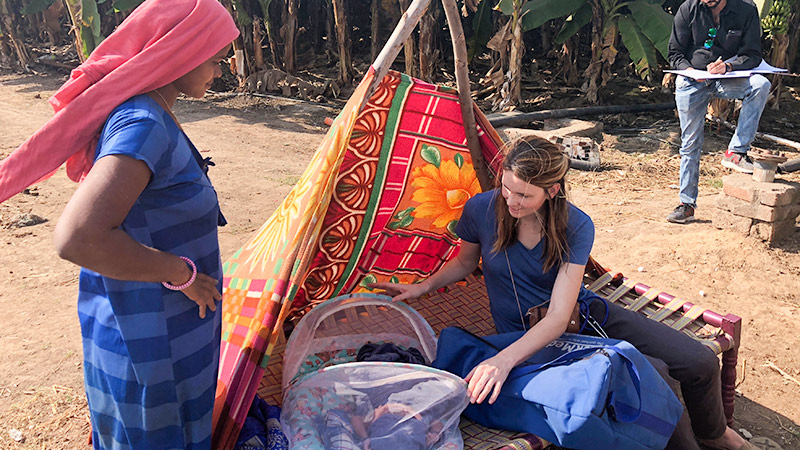
Students who enroll in this 10-credit certificate will acquire practical knowledge and skills about health systems in low resource areas, cultural, social and environmental determinants of health care delivery and care seeking. This knowledge is not only applicable abroad, but is critical when caring for vulnerable, marginalized populations in the U.S. (i.e., refugee populations) and will help students to be become well rounded medical professionals.
| Subject | Course # | Course title | Credits | Type of course | Offered | |
|---|---|---|---|---|---|---|
| GLBH | 60804 | Medical Innovation in Underserved and Global Health | 3 | Required | Fall | |
| GLBH | 60802 | Health Systems – Value, Quality, Cost | 3 | Required | Fall | |
| GLBH | 60805 | Immersion in Global and Underserved Health | 4 | Required | Summer, fall and spring | |
| TOTAL CREDITS: 10 | ||||||
Course Descriptions
Course descriptions for the Global Health & Innovation program can be found in the current edition of the NEOMED Compass, the University Catalog and Student Handbook.
Program Goals and Objectives
Objective 1
Promote leadership through knowledge and understanding of global health care disease burden and change theory within industry, health systems, and academics.
- 1.1. Recognize and examine global disease burden.
- 1.2. Foster analytical decision-making skills.
- 1.3. Integrate regular self-assessment to optimize management styles and techniques for continuous improvement.
- 1.4. Convey a change theory process to meet organizational and patient needs.
- 1.5. Implement knowledge of global health systems functions to achieve intended outcomes.
Objective 2
Facilitate awareness and knowledge of biomedical innovation through principles and practical experience.
- 2.1. Demonstrate knowledge of the principles of biomedical innovation and human-centered design.
- 2.2. Incorporate evidence-based medicine methods for biomedical innovation.
- 2.3. Effectively conceptualize human-centered design processes to achieve intended outcomes.
- 2.4. Demonstrate the ability to analyze and communicate the results through data visualization.
Objective 3
Provide immersion experiences for students to broaden their perspective of health care.
- 3.1. Demonstrate ability to engage in ethical and respectful relations with stakeholders.
- 3.2. Identify and explain examples of cultural determinants of health and disease.
- 3.3. Collaborate with partner institutions through research and clinical experiences.
- 3.4. Observe, record, and analyze data.
- 3.5. Compare and contrast heath care disparities within differently resourced environments.
- 3.6. Understand practical issues in health care that influence innovation.
Contact
College of Graduate Studies Admissions
- Request more information about this degree
- Have a question? COGSAdmissions@neomed.edu
The Graduate School at NEOMED
College of Graduate Studies degrees
College of Graduate Studies home

© 2024 Northeast Ohio Medical University
4209 St. Rt. 44, PO Box 95, Rootstown, Ohio 44272
Report an accessibility issue | Consumer information | Title IX | Privacy statement | Do business with NEOMED