


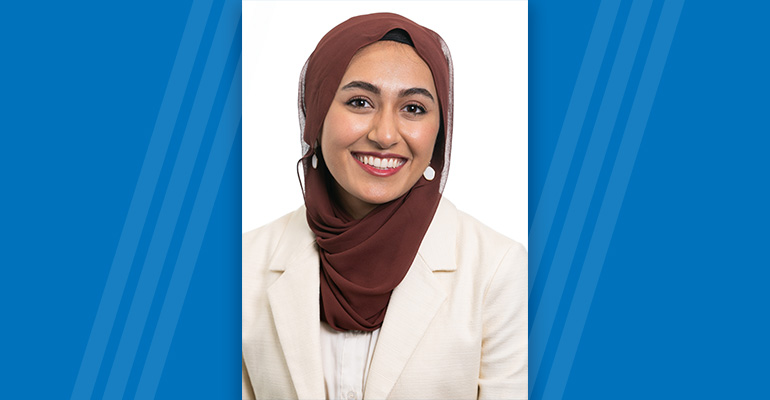
Third-year medical student Sara Khan was accepted to the Exploring DBP program, enabling her to travel to the Society for Developmental and Behavioral Pediatrics (SDBP) conference held in New Orleans, Louisiana, in October. The Exploring DBP program awards provide a unique opportunity for medical students, pediatric residents and second career pediatricians to experience the subspecialty of DBP.
Khan shared her reflections on the experience with The Pulse in the hopes of increasing autism awareness and interest in developmental and behavioral pediatrics (DBP).
By Sara Khan
The sight of palm trees in October was quite surreal. New Orleans was buzzing with life, as majestic, historical architecture melded with an edgy, urban atmosphere. In this vibrant city, I attended the most vibrant conference, the annual meeting of the Society for Developmental and Behavioral Pediatrics (SDBP). And it was all thanks to Exploring DBP – a program that sponsors a select number of medical students and residents to attend the conference, free of cost. Exploring DBP was created in honor of Dr. Nancy Shashaty, a legend in DBP history. Raised in a time when women were just beginning to occupy the medical field, she championed the needs of children with disabilities and did so up until her death in 2018. In her memory, her family supports the Exploring DBP program, with hope that the field of DBP continues to recruit new, passionate medical professionals.
This hope is more relevant than ever. There are around 830 DBPs in the U.S., and the demand for their services is about 10 times that. One presenter calculated that to perform the number of clinical evaluations currently needed in the U.S., they would have to see 60 new patients every day, 365 days a year. DBPs serve a very vulnerable population: children with autism, Down syndrome, cerebral palsy, spina bifida, ADHD and global developmental delay are just a few examples, and many require complex care for other comorbidities. DBPs will diagnose conditions, monitor development, manage medications and referrals, and educate families on community supports. These doctors play the important role of guiding families through overwhelming moments, giving parents the knowledge, hope and encouragement they need to navigate a new diagnosis.
I discovered my interest in developmental disabilities during my freshman year of college, when I began volunteering for The Rich Center for Autism in Youngstown. I knew I wanted to work in mental health, and this felt adjacent to my goals. What I did not expect was just how amazing the kids would be, and how rewarding it was to work with them. As is the case with all children, there were behaviors that were challenging. But connecting with them on their interests and supporting their sensory needs was all it took to create trust and love. It was these bonds that would shape the rest of my career. Now, every step I take towards DBP is propelled by memories of the kids from The Rich Center. They were on my mind in New Orleans, as I heard from physicians, therapists and other professionals who are working to help children like them.
It was refreshing to be surrounded by others who are passionate about this patient population. I had the pleasure of connecting with DBPs from Cincinnati Children’s Hospital, our neighbors down in NEOMED’s southwest campus. I also had breakfast with my mentor, Dr. Diane Langkamp from Akron Children’s Hospital, who had told me about Exploring DBP and encouraged me to apply. Exploring DBP hosted a panel of fellows (many of whom were past Explorers) as well as a panel of current DBPs, one of whom was a NEOMED alum! Finally, I was able to speak with the president of SDBP himself, Dr. Robert Voight, who had delivered a rousing presidential address. His speech remarked on the history of the field, as well as improvements to the training and practice of DBP. He ended the address in true New Orleans fashion, as trumpets blared and a marching band burst into the room. Everyone was on their feet, clapping along and jiving to the music. Even on the flight home, I am still in awe of the abundance of joy in these practitioners.
Key Takeaways
There were a lot of things I learned about DBP during the conference that surprised me. For example, DBPs can serve as expert witnesses, teach parenting classes, visit schools, work with early child intervention and help change healthcare policy. I even met a DBP who uses a custom RV as a clinical space! Dr. Noël Mensah-Bonsu operates this mobile clinic through her practice, The Developmental Journey, providing diagnostic evaluations to kids who otherwise couldn’t access them. Hearing from her and her colleagues reinforced the sheer versatility of developmental behavioral pediatrics, and the sessions I attended only added to my excitement. The first one was about the importance of play and how it contributes to brain development. This led to an after-hours session where attendees competed in high-energy, development-inspired games to reestablish play in our own lives. Other sessions I attended included hot topics in the field, such as deafness, disaster preparedness, ADHD management and advocacy. My major takeaway is this: there are so many facets to living with disabilities, and equally as many opportunities to help our patients – in the clinic, the classroom, the community and beyond.
With Gratitude
I want to thank the family of Dr. Nancy Shashaty and the organizers of Exploring DBP for orchestrating this wonderful experience for trainees. It allowed my view of DBP to expand far beyond the clinical space and learn what it means to serve a community as a physician. I was struck by how creative and determined these doctors were in finding ways to help their patients – and I am excited to let my own imagination fuel my future. I was equally drawn to the fact that each physician had a distinct niche within the specialty, showing me how well this field can be tailored to specific interests. Developmental and behavioral pediatrics has so much to offer, and I hope more trainees are inspired to pursue it.
If you are interested in Exploring DBP, check out sdbp.org for more details, and consider applying for next year’s cohort.
And if you get the chance, take a trip down to New Orleans – it’s a city you won’t forget!