Zelman’s Tikkun Olam: Let’s start with early education
Feb. 13, 2023
Recently, several news media outlets reported that an Ohio couple had been supplying “Nazi-approved material” for homeschooling. The reports mention that while the Ohio Department of Education is investigating the homeschooling network involved, it appears that such curriculum does not violate state law. One report adds that there is no meaningful review of homeschooling curriculum in Ohio law and that “now” state leaders are calling for more homeschooling regulations.
Now?!
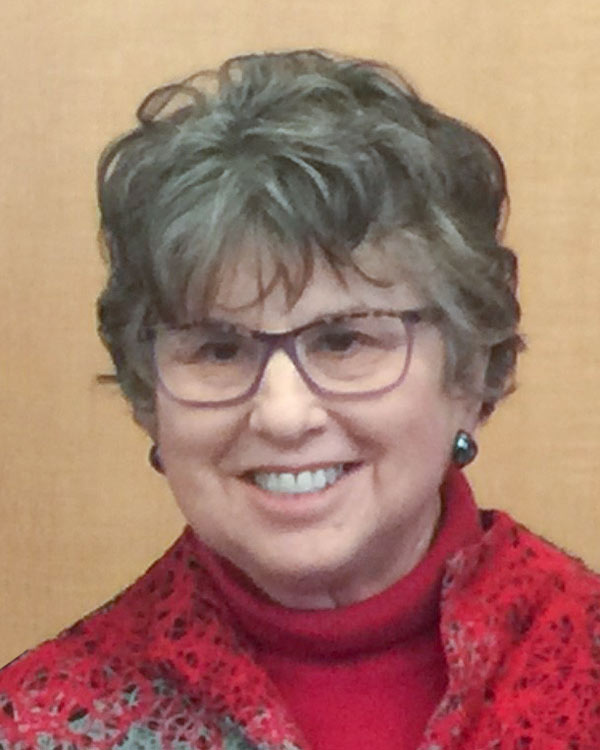 Susan Tave Zelman, Ph.D., a former teacher, state education administrator and granddaughter of Russian-Jewish immigrants, who talked to us about her new book, The Buying and Selling of American Education, Reimagining a System of Schools for All Children, might have a few choice words about the homeschooling story — but our interview with Zelman took place before the homeschooling story was first reported. Notwithstanding its antisemitism, which has been on a notable rise, and despite the growing interest of homeschooling in general, due to concerns ranging from COVID and school safety to curricular preferences and students with unique needs, the central topic of accountability for education would probably dictate much of Zelman’s response to such reports. And perhaps, she would’ve replied, ‘and that’s why I wrote this book!’
To make this world a better place, we must start with early education.
For complete disclosure, Zelman is a Northeast Ohio Medical University Board Trustee. This story does not represent a book endorsement by the University.
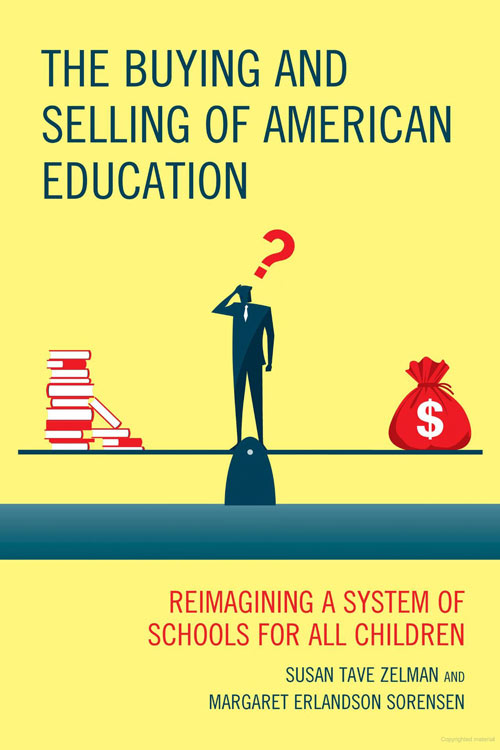 Co-written by Margaret Erlandson Sorensen, The Buying and Selling of American Education, lays out the history of American education beginning with the colonial era. America’s system of primary and secondary public education during periods of growth and decline as well as comparative dominance and sub-standardization has been well-documented in other publications; but Zelman’s depiction might separate itself in three ways:
- the notion that there’s more to education than economic development — there’s quality of life and of the mind;
- the contention of what she refers to in the interview as “dark money” in school board races; and
- the need for accountable pluralism.
Zelman said, “I think we need federal and state tax for a strong infusion of public dollars. But one can’t understand a school’s funding unless they understand taxing policy.”
BUILDING A BETTER SYSTEM
The foundation of her understanding began at Hunter College, where she majored in history and minored in political science. Zelman then taught high school social studies in the New York City schools before attending the University of Michigan to pursue a doctorate in education. Raising three kids along the way with her husband, Allan, she spent 14 years in academia. When she moved on to state politics, she realized that “people who wanted to reform education didn’t know, appreciate or understand anything about America’s past history.”
With a goal of bringing positive change to education policy, Zelman never looked back, serving first as an associate commissioner of education in Massachusetts, then a deputy commissioner of education in Missouri before serving 10 years as state superintendent for public instruction in Ohio. After a brief stint with the Corporation for Public Broadcasting, Zelman returned to the Ohio Department of Education as its executive director.
Now retired, Zelman said, “We’ve been working on education reform for the past 40 years and we’re not really moving the needle — we need to do a better job, particularly with children and families on the margins!
“There are five issues confronting American Education today: curriculum and assessment, the teaching profession, school choice, community engagement and civic participation, and school governance and funding.”
She contends that American educational reformer and slavery abolitionist Horace Mann’s common system of schools, while idyllic with its goals of equal access and equity, has historically proven to not be very effective. Yet, the notion and the vision “leads us to deny the reality that schools and districts differ widely in the needs of students, the resources to meet their learning objectives, and their success in doing so.”
Neither raising standards with high-stake assessments nor lowering them while reducing accountability is the answer, concludes Zelman. “We need to provide better choices for children and their families and move our existing system of commonality to a more pluralistic system of public education,” she said.
In the book, Zelman and Sorensen make it clear what a pluralistic system is not:
A pluralistic system is not a single federal system or state government takeover. It is not allowing a group of anxious parents to dictate what will or will not be taught in schools. It is not a privatization of education with no accountability.
And the authors have even more to say about what it is:
We define a pluralistic system as having a multiplicity of schools that incorporate a range of education best practices and provide families and students with options. A pluralistic system may allow two or more sources of authority to co-exist, which affirms our nation’s democratic principles and addresses the need for a strong accountability system that demonstrates academic outcomes. It would support and encourage educational innovation through new models that respect different beliefs, conditions, and lifestyles of diverse populations. The system creates a strong human resource system for the profession and encourages robust community engagement and civic participation.
All of which they say address the previously noted five issues with America’s education system.
Zelman says that she’s become provocative because she is tired of status quo education reform. America needs a system of accountable pluralism. Zelman says she would design it like an XPRIZE competition for public education, addressing the needs of community, based on some fundamental principles that prepare students for:
- confronting a future we cannot imagine;
- being critical thinkers and innovators;
- establishing the psychological dispositions to be able to learn new knowledge and skills in their professional lives and to assist in the economic growth of the nation
- becoming lifelong learners;
- valuing American democracy and civic culture;
- practicing good stewardship of our planet, protecting it for generations to come;
- using technologies to benefit and not harm humanity;
- appreciating human values, including honesty, loyalty, integrity, civic engagement, civility, kindness, caring and sharing; and
- appreciating diversity and inclusion.
And if compromise is needed, which of those principles should we not be willing to let go?
“Individual civil rights, using technologies to benefit and not harm humanity, and appreciating human values, including honesty, loyalty, integrity, civic engagement, civility kindness, caring and sharing,” she said.
Although Zelman intended to start writing this book in 2012, she put it on hold when she was appointed to the Ohio Department of Education. When she retired in 2018, she began writing it with Sorensen.
“But I really started working on it when I was in the sixth grade," Zelman said.
EARLY LESSONS
“My father was from the lower eastside of the Bronx. I was a post-war [WWII] baby. It was hard to find housing. So, we lived in the Marble Hill Housing Projects — bordering Bronx and Manhattan — for nine years,” Zelman noted. “He went to City College and Brooklyn Law School. Education got my parents out of poverty. Education leads to social mobility.”
But Zelman realized early on that the education experience wasn’t the same for everyone.
Zelman recalled, “Ernest Gibbs was his name. A young black boy from Harlem. He was new to my neighborhood and so my mom said, ‘he’s new, so be nice to him, walk with him to school and show him around.’
“We became friends. He was in my class and we’d walk to school together. On the way to school one day, he said they were moving him down to 5th grade. It didn’t make sense to me. He was a smart kid. Why would they move him to a class with younger students?
“So, I asked our teacher, Ms. Eisner, and she said because ‘he came from Harlem and schools are not as good as they were in PS-122.’”
This affected Zelman throughout her life. And although her dad wanted her to become a lawyer, both she and her sister became teachers. Zelman knew then that teaching was one of the most important professions in the world as it is the foundation to every future professional including lawyers, doctors, clerks and laborers.
After finishing college early, she taught at Grace Dodge Vocational High School — located across from the Bronx Zoo. While there, she experienced more of the same.
“I became a teacher at the age of 20. I remember in the teacher’s lounge, they would talk about the students and say things like, ‘You couldn’t tell the difference between the high school and the Bronx Zoo,’” Zelman said. “I was offended by that. I would get up and walk out.
“I realized that some of my students came from very vulnerable conditions. I was amazed at their strength and ability to cope and show up to school every day. They had to change subways and they made it there despite the challenges.”
This was frustrating to her.
“Desegregation policies were a fiasco. Education was part of other systems — social, economic and political. Banking and housing added to its demise,” Zelman said.
REPAIR THE WORLD
“Our system is designed around the needs of adults and not the needs of children; we all have vested interests — professionals (academics, teachers, administrators), parents, producers, publishers, politicians, plutocrats and partisans.”
In the book, Zelman discusses nations with high-performing education systems, writing that “strong professional standards are well-grounded in curriculum content and pedagogy and emphasize research-informed methodology and collaborative peer learning.”
She says that America has been resistant to change and can no longer afford to do so.
“They [successful international schools] sort of remind me of NEOMED,” Zelman said. “Although higher ed is usually slow to change, NEOMED uses Six Sigma, collaboration and other business principles to accelerate and bring positive change to the community.”
“In the Jewish community, we call it Tikkun Olam, or repair of the world,” said Zelman. “And public education is a good place to start.”